


The Price of Familiarity: Why Your Spreadsheet is a Growth Anchor
As a business owner, you live and breathe metrics. Revenue growth, profit margins, customer acquisition cost, operational expenditure. You built your company from the ground up, likely with a suite of familiar, reliable tools. At the heart of this toolkit, for many, lies the humble spreadsheet—a digital ledger that has served as the de facto command center for contacts, sales pipelines, and project tracking.
It worked. It was simple, inexpensive, and infinitely flexible. But the very flexibility that made it indispensable in the early days is now becoming a strategic liability. As your business scales, that familiar grid of cells transforms from a helpful tool into a ceiling—a hard limit on your efficiency, visibility, and potential for growth. You’re not just managing data anymore; you’re managing the chaos born from data fragmentation.
Every hour an employee spends manually cross-referencing spreadsheets, updating contact information, or generating reports is a direct tax on your operational efficiency. It’s a hidden cost that doesn’t appear on a balance sheet but silently erodes your bottom line.
The Cascade of Inefficiency: A System Under Strain
Let’s diagnose the symptoms of hitting the spreadsheet ceiling. Do any of these operational frictions sound familiar?
- Data Silos: Your sales team has one version of a client’s history, customer service has another, and marketing is working off a third, outdated list. There is no single source of truth, leading to embarrassing miscommunications and missed opportunities.
- Revenue Leakage: A promising lead is followed up by two different salespeople. A renewal reminder for a key client is missed because the responsible person is on leave. These aren’t isolated incidents; they are systemic failures caused by a lack of automated workflows and centralized oversight.
- Zero Predictive Power: You can see past sales, but can you accurately forecast next quarter’s pipeline? Spreadsheets are reactive. They tell you what happened, but they offer little to no insight into what will happen, making strategic planning a high-stakes guessing game.
- The Human Error Factor: A typo in a phone number, a deal stage incorrectly updated, a formula accidentally deleted. In a manual system, these small errors compound, leading to lost deals, inaccurate reports, and flawed business decisions made by you and your leadership team.

Beyond a Digital Rolodex: What Customer Relationship Management (CRM) Truly Is
It’s crucial to dismantle a common misconception. A CRM is not just a glorified contact list or a tool exclusively for the sales team. Thinking of it that way is like viewing a smartphone as merely a device for making calls. The reality is far more transformative.
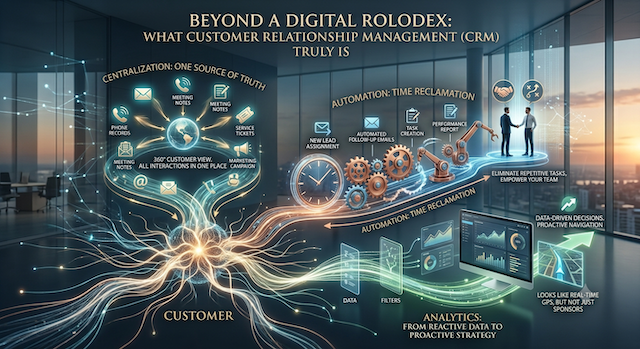
A modern CRM is the central nervous system of your business. It’s an operating system designed to unify every customer-facing interaction—from the first marketing touchpoint to the final invoice and ongoing support—into a single, cohesive, and intelligent workflow.
At its core, a true CRM platform is built on three strategic pillars that directly address the failings of a spreadsheet-driven operation:
1. Centralization: The Single Source of Truth
Imagine every email, phone call, meeting note, quote, and support ticket related to a single client being automatically logged in one accessible place. When your sales team engages a lead, they see the marketing campaigns that engaged them. When customer service receives a call, they see the client’s entire purchase history. This 360-degree view eliminates internal friction and presents a unified, professional front to your customers.
2. Automation: Reclaiming Your Most Valuable Asset—Time
A CRM is an engine for automation. It takes the repetitive, low-value tasks that consume your team’s day and executes them flawlessly. Examples include:
- Automatically assigning new leads to the correct salesperson based on territory or industry.
- Sending automated follow-up emails to nurture prospects through the sales funnel.
- Creating tasks and reminders for contract renewals or project milestones.
- Generating daily or weekly performance reports for your leadership team without any manual data entry.
This doesn’t replace your people; it empowers them to focus on high-value activities: building relationships, strategic selling, and solving complex customer problems.
3. Analytics: From Reactive Data to Proactive Strategy
With all your data flowing through a central system, you unlock powerful analytical capabilities. Instead of wondering which marketing channels are effective, you can see a direct line from a campaign to a closed deal. Instead of guessing why you lose deals, you can identify bottlenecks in your sales process where prospects consistently drop off. This is the shift from running your business through the rearview mirror to navigating with a real-time GPS, allowing you to make data-driven decisions with confidence.
The Critical Juncture: 5 Signs Your Business is Screaming for a CRM
How do you know when you’ve passed the point of no return with manual methods? The signs are often clear indicators that your current processes are actively preventing growth.
- Your Sales Pipeline is a “Black Box”: If you have to personally ask each salesperson for an update to understand your cash flow forecast, your pipeline is a black box. A CRM provides a visual, real-time dashboard of every deal, its stage, its value, and the probability of closing.
- Onboarding and Handovers are a Nightmare: When a key employee leaves, do they take all their client knowledge and deal history with them? If customer relationships live in individual inboxes and spreadsheets, you have a major business continuity risk. A CRM ensures that all this institutional knowledge is owned by the company, not the individual.
- Customer Experience is Inconsistent: Customers complain about having to repeat their issues to different team members. This is a classic symptom of data silos. A CRM provides a unified timeline of every interaction, ensuring any team member can pick up a conversation with full context.
- You Have No Visibility on Team Activity: You know your team is busy, but you can’t quantify their activities. How many calls were made? How many proposals were sent? A CRM tracks these key performance indicators (KPIs) automatically, giving you objective insight into productivity and performance without micromanaging.
- Growth Has Stalled: Perhaps the most telling sign. You have a great product or service, but your lead conversion rates are flat, customer churn is creeping up, and your team seems to be running faster just to stay in the same place. This is a classic sign of process breakdown. You haven’t outgrown your market; you’ve outgrown your operational infrastructure.
The Strategic Leap: From Fragmented Tools to an Integrated Business Platform
Recognizing the need for a CRM is the first step. The second, and arguably more critical step, is choosing the right approach. The market is flooded with standalone tools—one for email marketing, another for project management, a third for sales tracking. This often leads to a “digital Frankenstein,” a collection of apps that don’t communicate, require expensive monthly subscriptions, and recreate the very data silo problem you’re trying to solve.
For businesses in demanding sectors like Manufacturing, Construction, and Retail, this fragmented model is untenable. You need a single, powerful platform that can manage everything from lead acquisition and sales to complex project execution and inventory-aware customer service. This is where the concept of an all-in-one business platform becomes a game-changer.

A Case Study in Transformation: “Apex Construction”
Consider Apex Construction, a mid-sized general contractor. Their operations were run on spreadsheets for bidding, WhatsApp for site-to-office communication, and a separate accounting system. The CEO felt completely blind; project delays were common because of miscommunication, high-value change orders were falling through the cracks, and sales leads from their website were often not followed up for days.
By partnering with an implementation specialist like Toco Solution, they deployed Bitrix24, a unified CRM and business management platform. The transformation was profound:
- Unified Lead & Bid Management: All incoming leads were captured directly into the CRM, and an automated workflow was created for the bidding and estimation process, ensuring no opportunity was ever missed.
- Integrated Project Management: Each closed deal automatically created a project workspace within the same system. Site managers could now use the mobile app to post daily logs, request materials, and update task progress—all visible in real-time to the CEO and back-office staff.
- Transparent Financials: The platform was integrated with their accounting software, linking project milestones to invoicing. This dramatically improved cash flow and gave the CEO a clear view of project profitability.
The result? Apex Construction reduced their average bid response time by 40%, improved project completion times by 15%, and captured an estimated 8% in previously lost revenue from unbilled change orders within the first year. This wasn’t just a software upgrade; it was a fundamental business transformation driven by a centralized, intelligent system.
Your Next Move as a Leader: Building a Foundation for Growth
As a founder or CEO, your primary role is to build a resilient, scalable organization. The tools and processes that brought you to where you are today are not the ones that will take you to the next level. Moving beyond the spreadsheet ceiling isn’t just about adopting new technology; it’s a strategic decision to invest in visibility, efficiency, and a superior customer experience.
The right CRM platform, implemented by a partner who understands the unique workflows of your industry, is the foundation upon which that future growth is built.
Ready to Break Through Your Operational Ceiling?
If the challenges of manual processes, data silos, and revenue leakage resonate with you, it’s time for a strategic conversation. Toco Solution specializes in implementing the powerful, all-in-one Bitrix24 platform for businesses in the Manufacturing, Construction, and Retail sectors. We don’t just sell software; we engineer custom workflows that solve your specific operational pain points.
Let’s discuss how a tailored digital transformation can provide you with the control, visibility, and automation you need to scale with confidence. Contact a Toco Solution representative today to schedule your complimentary business process assessment.